
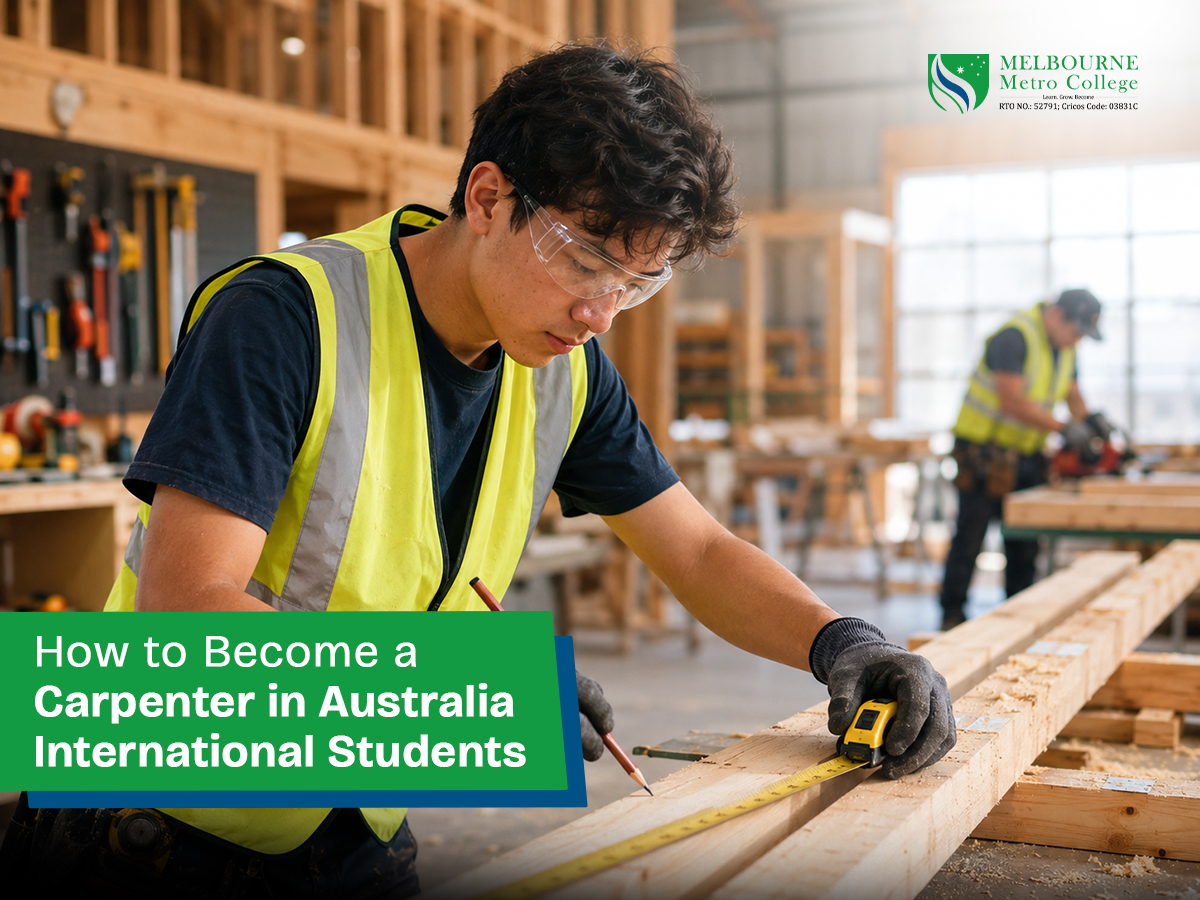
How to Become a Carpenter in Australia | International Students

International student measuring timber during carpentry training at Melbourne Metro College

To become a carpenter in Australia, you generally need practical construction training, workplace safety knowledge and a nationally recognised qualification such as CPC30220 Certificate III in Carpentry . International students commonly complete this qualification through a CRICOS-registered training provider instead of following the standard employer-based apprenticeship pathway.This guide explains what carpenters do, how the international-student pathway differs from an apprenticeship, and the steps involved in gaining the qualification.

What Does a Carpenter Do?

A carpenter constructs, installs, repairs and renovates building structures made from timber and other materials, working across residential homes, commercial buildings, renovations, formwork and interior fit-outs. Typical responsibilities include reading construction plans, measuring and calculating materials, constructing floor, wall and roof frames, installing windows, doors and cladding, and following construction safety procedures. CPC30220 prepares graduates for outcomes such as residential carpenter, commercial carpenter and formwork carpenter.

What Skills Does a Carpenter Need?

Carpentry combines hands-on trade ability with problem-solving and communication. Alongside CPC30220, employers generally look for measurement and construction maths, safe tool use, timber framing, physical stamina, and strong workplace safety awareness.
These foundations are built progressively throughout CPC30220 and continue developing on the job after graduation.

For a detailed breakdown of each skill and how to develop it, read our full guide :

What Qualifications Do You Need to Become a Carpenter in Australia?

The main nationally recognised trade qualification is CPC30220 Certificate III in Carpentry, made up of 27 core units and 7 elective units (34 units in total). The course covers setting out, framing, roofing, flooring, formwork and workplace safety, and students must demonstrate competency in every required unit before receiving the qualification.

Apprenticeship vs CRICOS-Registered Carpentry Course

There are two main ways to gain this qualification in Australia.

Factor Carpentry Apprenticeship CRICOS Carpentry Course
Employer required Yes, with a registered training contract Not required before course enrolment
Common pathway for People eligible to enter an Australian apprenticeship International students seeking structured full-time study
Typical duration Four years full-time in Victoria 52 weeks at MMC
Delivery Paid employment plus RTO training Classroom, workshop and structured assessment

Both delivery pathways may lead to CPC30220 Certificate III in Carpentry. However, the structure, duration and amount of workplace experience differ.International students should not assume they can enter a standard apprenticeship on a Student Visa, since it requires an employer and a registered training contract. Most Student Visa holders are also limited to working 48 hours per fortnight while their course is in session, and visa conditions can change, so it's worth confirming current rules via VEVO or the Department of Home Affairs.

How to Become a Carpenter in Australia: Six Key Steps

Close-up of hands using a hand saw to cut timber during carpentry skills training

Understand the profession

Carpentry involves physical, hands-on work reading plans, using tools safely, and working indoors, outdoors and at heights.

Choose the right training pathway

Domestic students may pursue an apprenticeship; international students typically choose a CRICOS-registered CPC30220 course. Compare RTO/CRICOS registration, course duration, entry requirements, fees and campus location before enrolling.

Check entry requirements

These vary by provider but often include a minimum age, prior education, English-language proficiency, and a course-entry interview. Melbourne Metro College requires applicants to be at least 18 at course commencement.

Complete White Card training

People carrying out construction work in Victoria must hold a valid construction induction card, commonly called a White Card. MMC currently lists successful completion of the relevant general construction induction unit as an entry requirement for CPC30220. Applicants should confirm the current requirement with MMC before enrolling.

Complete CPC30220 Certificate III in Carpentry

Training covers tool use, measurements, framing, roofing, formwork and safety. MMC delivers this over 52 weeks (40 weeks training, 12 weeks scheduled holidays).

Prepare for employment or further study. 

Graduates can pursue entry-level roles in residential or commercial carpentry, or progress to Certificate IV or Diploma-level building and construction qualifications. Completing CPC30220 does not itself provide a builder’s licence or contractor registration.

How Long Does It Take to Become a Carpenter in Australia?

A Victorian carpentry apprenticeship generally takes four years full-time. A CRICOS-registered course for international students, such as MMC's CPC30220 program, runs 52 weeks full-time. The two shouldn't be compared on duration alone: apprentices build experience through paid employment over several years, while a CRICOS course follows a structured training and assessment schedule, and graduates may still need to gain workplace experience afterward.

Is Carpentry a Good Career in Australia?

Carpentry can be a rewarding career for people who enjoy practical construction work, problem-solving and working with tools and materials. Jobs and Skills Australia reports approximately 104,900 people employed as Carpenters and 149,900 across the broader Carpenters and Joiners occupation group. Median full-time earnings for the broader group are $1,760 per week before tax (around $91,500 per year) — a useful national baseline, though actual earnings vary by experience, location, specialisation and employment arrangement.

Why Study Carpentry at Melbourne Metro College?

Melbourne Metro College is a Registered Training Organisation and CRICOS provider delivering CPC30220 Certificate III in Carpentry in Melbourne.

Course detail Information
Qualification CPC30220 Certificate III in Carpentry
RTO code 52791
CRICOS provider code 03831C
CRICOS course code 120738D
Duration 52 weeks (40 training + 12 holidays)
Qualification structure 27 core + 7 elective units
Minimum age 18 at course commencement
Contact the admissions team to confirm current intake dates, fees, English requirements and campus details.

Frequently Asked Questions

Can international students study carpentry in Australia?

Yes. International students can enrol in an approved CRICOS-registered carpentry course, provided they meet the provider's entry requirements and comply with their Student Visa conditions.

An apprenticeship requires an employer and training contract, typically taking four years full-time in Victoria. A CRICOS course is delivered by an approved provider over about 52 weeks, without requiring an employer before enrolment. Both can lead to CPC30220 Certificate III in Carpentry.

Yes. Students need approved general construction induction training before carrying out construction work, and MMC lists this as part of its CPC30220 entry conditions.

MMC ( Melbourne Metro College ) delivers CPC30220 over 52 weeks, including 40 weeks of structured training and 12 weeks of scheduled holidays.

Yes. Carpentry offers strong job security, with around Around 150,000 people employed nationally depending on category, and sits on the Medium and Long-term Strategic Skills List, which is relevant to some skilled migration visa categories. Listing on this list does not guarantee a visa outcome, and eligibility depends on individual circumstances - always confirm current settings with the Department of Home Affairs.

Jobs and Skills Australia reports median full-time earnings of $1,760 per week before tax for the broader Carpenters and Joiners occupation group. Earnings vary according to experience, hours, specialisation, employment arrangement and location.

Most Student Visa holders can work up to 48 hours per fortnight while their course is in session. Rules can change, so confirm current work rights via VEVO or the Department of Home Affairs.


Content disclaimer: This information is general and current as of July 2026. Course requirements, visa conditions, employment rules and government policies may change. Completing CPC30220 does not guarantee employment, sponsorship, licensing, permanent residency or any other migration outcome.

Share it :

Leave a Reply

Your email address will not be published. Required fields are marked *